How we ship in days what takes others months
There is a particular species of meeting that exists only inside traditional creative agencies. It involves eleven people, a shared screen, and ninety minutes of discussion about whether the headline font should be 2px larger. By the end, everyone agrees to "circle back next week." The client gets an update email. The email says "making great progress." Progress has, in fact, been made on exactly one thing: the collective understanding that Wednesdays are for wasting.
We find this ritual fascinating the way an anthropologist finds cargo cults fascinating. Interesting to study. Baffling to participate in.
TaleCrafters ships fast. Full campaigns. Polished video. Motion design that would make a traditional post house quietly close their laptop and reconsider their career. And we do it consistently, predictably, and at a quality level that makes people suspicious. "There must be a catch," they say. There is. The catch is that we built the entire operation around the principle that speed and quality are the same thing when you remove the bureaucratic sludge that separates them.
Why Everyone Else Is Slow
Creative agencies are slow for the same reason governments are slow. The structures that were designed to ensure quality have, over time, become the primary obstacles to it. Every layer of approval, every review committee, every "stakeholder alignment session" adds time while subtracting clarity.
The typical agency workflow looks like this: Brief comes in. Account manager translates the brief for the strategist. Strategist writes a strategy document. Creative director interprets the strategy document. Designer creates concepts. Concepts go to internal review. Internal review generates feedback. Feedback goes back to the designer. Revised concepts go to the client. Client generates more feedback. Feedback gets filtered through the account manager. And somewhere around week six, a first draft emerges that satisfies everyone just enough to survive.
This process exists because agencies charge by the hour and complexity justifies headcount. Every meeting is billable. Every revision cycle is revenue. Speed is, structurally speaking, against the financial interests of the traditional model.
We thought about that for approximately four seconds before deciding to build something entirely different.
The Architecture of Velocity
Our speed comes from three deliberate structural choices, each one designed to compress the distance between idea and finished product.
One: Flat creative authority. The person making the creative decisions is the person making the creative work. We eliminated the telephone game of briefs being reinterpreted through five layers of management until the original idea is unrecognisable. One creative lead per project. Full authority. Full accountability. The same brain that conceives the idea executes it, which means zero translation loss and zero waiting for approval from someone three time zones away who read the brief on their phone between meetings.
Two: Synthetic media as production infrastructure. Traditional video production requires location scouts, crew bookings, equipment rentals, weather contingencies, catering budgets, and the quiet prayer that the talent shows up sober. We've replaced entire production pipelines with synthetic media workflows that generate cinema-grade output in hours. The technology handles the heavy lifting. The humans handle taste, narrative, and the thousand micro-decisions that separate compelling content from technically impressive content that leaves everyone cold.
Three: Scope precision. Most creative projects balloon because the scope was vague from the start. "Let's create some content" is a scope. It's also an invitation to spend eight weeks figuring out what "some content" actually means. We define deliverables down to the frame count before any creative work begins. Every project has a finish line visible from the starting blocks.
Speed as Compound Interest
Here's where it gets interesting. Speed is usually discussed as a convenience. "We deliver fast" sounds like a nice operational perk, the creative equivalent of free next-day shipping. In reality, speed is a compound strategic advantage that reshapes everything it touches.
Speed changes the creative risk calculus. When a piece of content takes three months to produce, the stakes are enormous. The client needs it to be perfect because the cost of failure is three months of budget and morale. So they play it safe. They choose the least objectionable option. They optimise for "fine" because the downside of "bold" is too expensive to absorb.
When the same content takes three days? Suddenly bold becomes affordable. The cost of an experiment that misses is three days, and the potential upside is a breakthrough that defines your brand for a quarter. Speed transforms the risk equation from "we need to get this right" to "let's try five things and keep the one that hits hardest."
That shift produces categorically better creative work. Every time.
Speed earns trust faster. The traditional agency relationship is a slow courtship. Months of pitching. Weeks of onboarding. A cautious first project where everyone is polite and the work is safe. Real trust develops around month eight, which is also approximately when the first interesting work gets approved.
We compress that cycle by delivering exceptional work so fast that clients run out of reasons to be cautious. By the end of week one, they've already seen what we're capable of. By week two, they're sending us the briefs they used to save for "later." By month one, we're the first call they make, because we've already proven that speed and quality live at the same address.
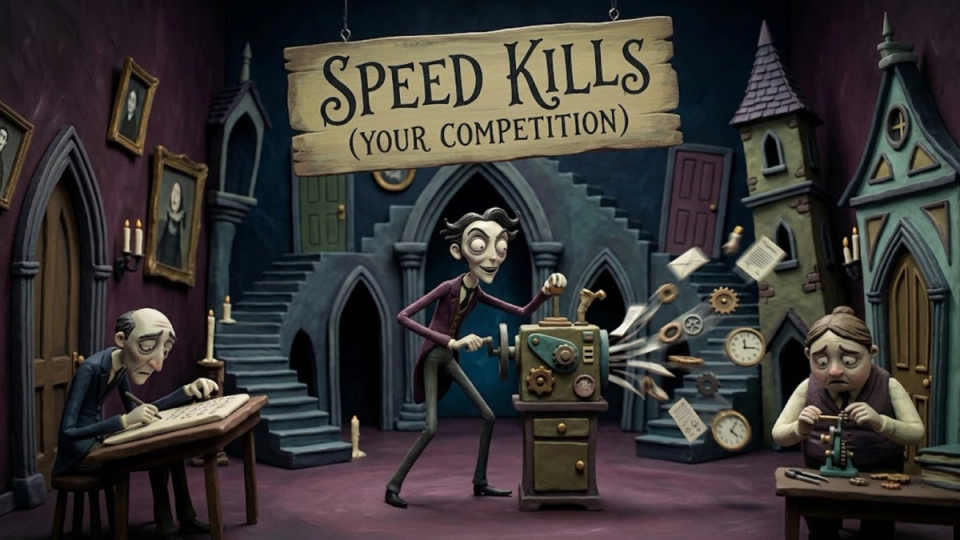
Speed creates a content moat. While your competitor is in revision round four of their Q2 campaign, you've already shipped three campaigns, tested what works, refined your approach, and launched a fourth. Compounded over a year, this velocity differential is devastating. You're running laps around organisations that are still lacing up their shoes.
The Mythology of "Taking Your Time"
The creative industry has romanticised slowness for decades. "Great work takes time." "Creativity demands patience." "We need to sit with this."
These statements sound wise. They are also, in most cases, elaborate excuses for operational inefficiency dressed up as artistic philosophy.
Great work takes focus. Great work takes taste. Great work takes decisiveness. What great work has zero use for is the fourteen-day gap between "concept approved" and "production begins" where the project sits in someone's inbox marinating in corporate inertia.
The myth of slow creativity protects a very specific set of interests: agencies that bill by the hour, creative directors who enjoy long lunches, and account managers whose entire role is managing the complexity that a simpler process would eliminate. Remove those interests from the equation and you discover something inconvenient. Most creative projects contain approximately forty hours of actual work spread across twelve weeks of process. The work itself was always fast. The system around it was slow.
What We Did Different
We looked at every stage of the traditional creative production pipeline and asked a single question: "Is this step making the work better, or is it making someone feel involved?"
The steps that made the work better, we kept and accelerated. Concept development. Visual direction. Narrative architecture. Sound design. Colour grading. The craft elements where human judgment creates the gap between good and extraordinary.
The steps that existed purely for process theatre, we eliminated entirely. Status meetings with twelve attendees. Approval chains that route through people who will rubber-stamp anyway. Presentation decks designed to sell work internally before anyone attempts to sell it externally. Revision rounds that exist because the brief was ambiguous, where a twenty-minute conversation would have resolved the ambiguity on day one.
What remains is a creative production system where the time between "yes, let's do this" and "here's the finished work" is measured in days. Sometimes hours. Consistently in single-digit increments that make traditional studios deeply uncomfortable.
The Speed Objection (And Why It Evaporates)
Every prospective client has the same initial reaction. "If you're that fast, the quality must suffer." This is a reasonable instinct. In most industries, speed and quality exist in tension. A restaurant that serves your meal in ninety seconds is probably serving something that came out of a microwave.
Creative production is different. The quality bottleneck in creative work has almost always been decisional. The technology was always fast enough. The humans were always talented enough. What killed timelines was the organisational apparatus wrapped around both.
We removed the apparatus. The talent and the technology remained. The work got faster and better, because decisiveness is itself a creative skill. The ability to commit to a direction, execute with precision, and ship with confidence produces work with an energy and coherence that committees and revision cycles systematically drain away.
Our fastest projects have consistently been our best. That correlation is structural.
The Bottom Line
Speed is a weapon. Wielded with taste and precision, it transforms every dimension of creative production. The work gets braver because experiments cost days, and a failed experiment that costs three days is just a lesson learned before lunch.
The relationship gets stronger because trust builds on evidence, and delivering exceptional work in seventy-two hours is the most compelling evidence available.
The competitive advantage compounds because while others deliberate, you iterate. While they plan, you ship. While they perfect a single piece, you've already tested five and identified the one that resonates.
We built TaleCrafters around a conviction that the creative industry's addiction to slowness is a choice, and choosing differently produces better work, happier clients, and the kind of output that makes competitors wonder what happened.
They'll figure it out eventually. By then, you'll be three quarters ahead.