
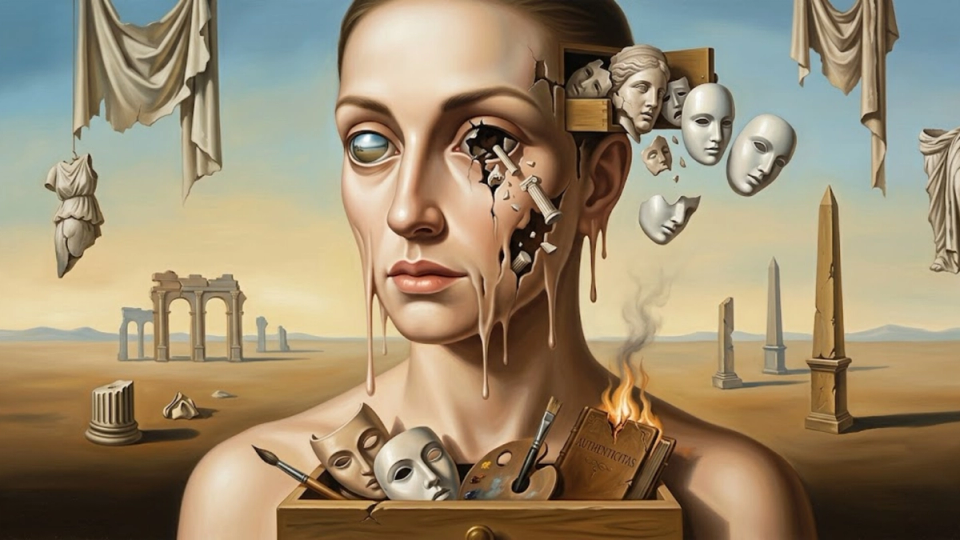
Everyone's authentic now. Which means no one is.
At some point in the last decade, a marketing executive stood in front of a whiteboard and wrote the word "authentic" in blue dry-erase marker, and the entire industry lost its collective mind.
Suddenly, every brand on earth needed to be authentic. Authentic voices. Authentic stories. Authentic behind-the-scenes content of the intern microwaving leftover pad thai because, hey, we're real people too. The word became gospel. It became a KPI. It became the answer to every brief, every strategy deck, every awkward brainstorm where someone inevitably said, "What if we just… showed the real us?"
And now, a decade later, "authentic" means the same thing as "synergy" meant in 2007. Everyone says it. Everyone claims it. The word has been bleached of all meaning, like a towel used to clean up so many spills it's become the same colour as everything else.
Welcome to the post-authentic era. It's exactly as absurd as it sounds.
How Authenticity Ate Itself
The lifecycle of a cultural concept follows a predictable arc. Someone discovers it. Early adopters weaponise it. The mainstream adopts it. And then it collapses under the weight of its own ubiquity, like a soufflé made from too much of everything.
Authenticity had its moment. A beautiful, genuine, culturally necessary moment. Audiences were starving for realness in a landscape of polished corporate nonsense. The first brands to drop the veneer and speak like actual humans earned enormous goodwill. They earned it because they were early. Because when one brand out of a thousand sounds human, it stands out like a heartbeat in a library.
When all thousand brands sound human? You just have a very loud library.
That's where we are. Every brand has a "raw" Instagram story. Every CEO has a "vulnerable" LinkedIn post. Every company page features a "candid" team photo where everyone looks just dishevelled enough to seem unplanned, taken by the photographer they hired three weeks in advance.
The performance of authenticity has replaced actual authenticity. And the audience knows. They always know.
The Vulnerability Industrial Complex
The most fascinating mutation of the authenticity era is the rise of performed vulnerability. Somewhere along the line, brands and founders discovered that sharing "struggles" was engagement gold. And so began the great vulnerability arms race.
"I almost quit last year." "We nearly went bankrupt." "I cried in the office bathroom on a Tuesday."
Every one of these posts follows the same three-act structure: the struggle, the breakthrough, the lesson. Every one of them is formatted for maximum emotional extraction. And every one of them, regardless of how true the underlying story might be, reads like content. Because it is content. Designed for feeds. Optimised for engagement. Packaged for consumption.
The audience sits there scrolling through a river of manufactured epiphanies, each one indistinguishable from the last, each one asking for the same emotional response. The ask is always the same: feel something for me, then like and share.
This is what happens when vulnerability becomes a tactic. The emotion becomes a formula. The confession becomes a content format. The human moment becomes a growth hack.
And growth hacks, by definition, have a shelf life.
The Audience Is Smarter Than Your Strategy
Here's what most brands underestimate catastrophically: audiences have been marinated in marketing for their entire lives. They grew up dodging pop-up ads. They watched influencer culture evolve from bedroom vlogs to multi-million-dollar production studios pretending to be bedroom vlogs. They have finely calibrated bullshit detectors, honed by years of being sold to by people pretending they were just hanging out.
These audiences can smell a brief at fifty paces. They can identify a "spontaneous" branded moment in under three seconds. They can tell the difference between a founder who actually cares and a founder performing care for a camera, even if they'd struggle to articulate exactly how.
The tells are subtle. The lighting is too good. The "casual" copy has been through four rounds of editing. The "off-the-cuff" video has a suspiciously clean jump cut at the 12-second mark. The "authentic" brand voice sounds remarkably like every other "authentic" brand voice, because they're all pulling from the same playbook, written by the same consultants, inspired by the same case studies.
When everyone runs the same play, the play stops working. That's basic competitive dynamics. Authenticity was a differentiator when it was rare. Now it's table stakes. And table stakes, by definition, give you zero advantage.
What Comes After Authentic
So if authenticity is dead as a strategy, what fills the vacuum?
Taste. Taste is the differentiator that scales with difficulty, because taste demands genuine conviction sustained over time. You can perform vulnerability for a quarter. You can maintain a "raw" aesthetic for six months. Taste requires a point of view that holds up across years, across formats, across the thousand small decisions that shape how a brand actually feels in the wild.
Taste is the reason some brands can post a single image with zero caption and generate more engagement than a competitor's twelve-slide carousel with custom illustrations. The image carries conviction. The carousel carries effort. The audience feels the difference instantly, even if they'd describe it simply as "that one just hits different."
Specificity. The authenticity era produced a paradox: everyone trying to sound "real" ended up sounding the same. The exit from that trap is radical specificity. The brands that land are the ones with a voice so particular, so textured, so theirs that copying it would feel immediately obvious. Specificity is the enemy of the generic. And the generic is where authenticity went to die.
Conviction. The most magnetic quality a brand can possess is the willingness to believe something and say it out loud, knowing full well that a percentage of the audience will disagree. Conviction is polarising by nature. It creates gravity. It forces a reaction. The alternative is the lukewarm middle, which is exactly where "authentic" brands have congregated, all nodding politely at each other while the audience scrolls past them in a bored haze.
The Irony Tax
There's a beautiful irony in all of this. The brands that are actually authentic, the ones operating from genuine conviction with a real point of view, are now penalised by the very word that was supposed to describe them. They live the thing. They just find themselves punished for saying the word out loud, because it has been so thoroughly strip-mined by pretenders that using it unironically signals the exact opposite of its meaning.
"Authentic" has become a tell. When a brand leads with it, the savvy audience hears: "We hired someone to figure out how to seem real." The word has boomeranged. What once signalled substance now signals strategy.
This is the irony tax. The authentic brands have to find entirely new language, while the performers keep squeezing the last drops out of a word that lost all weight three years ago.
So What Do You Actually Do
Stop describing yourself. The strongest brands operate with such clarity of voice that the audience supplies the adjective. They experience your content and they decide you're authentic, or bold, or interesting. The moment you claim the label yourself, you've undercut it. Your audience's perception is the only verdict that counts. Earn it through the work.
Kill the "behind-the-scenes" that looks like a production. If your raw content took four hours to produce, it's produced content. Own that. Polish it. Make it exceptional. Or make it actually raw, which means accepting that it will be messy, unflattering, and occasionally embarrassing. The middle ground, produced content wearing a raw costume, is where credibility goes to evaporate.
Have an actual opinion. About your industry. About your competitors. About the conventions your category treats as sacred. The safest brands in your space are also the most forgettable. Opinions create edges, and edges are what people remember. Take a position. Defend it with quality work. Accept that the audience you lose was already gone.
Invest in craft over confession. The vulnerability playbook is exhausted. The next era belongs to brands that put disproportionate energy into how good the work is, how thoughtfully it's made, how precisely it lands. Audiences are tired of being asked to feel things for brands. They want to feel things because of brands. That's the shift from emotional extraction to emotional creation. The latter gives something back, and the audience can tell.
The Bottom Line
Authenticity was a necessary correction. It dragged branding out of a sterile, corporate, inhuman era and forced it to reckon with the fact that people respond to people. That correction mattered. It was important. And it's over.
The word is a husk. The strategy is a commodity. Every brand on your timeline is "authentic" in the same predictable, workshopped, consultant-approved way, and the audience has already moved on. They just forgot to tell the marketing departments.
What comes next is harder, more interesting, and far more rewarding. It requires taste, specificity, and the spine to be genuinely distinctive in a landscape that rewards sameness.
The authenticity era asked brands to be real. The post-authentic era asks something scarier: be interesting.
Most brands will choose the safety of the familiar. The ones that matter already know which direction they're walking. TaleCrafters is a synthetic media studio that manufactures attention through stories that immerse and content that converts. We help brands escape the beige. Ready to conspire? Let's talk.