
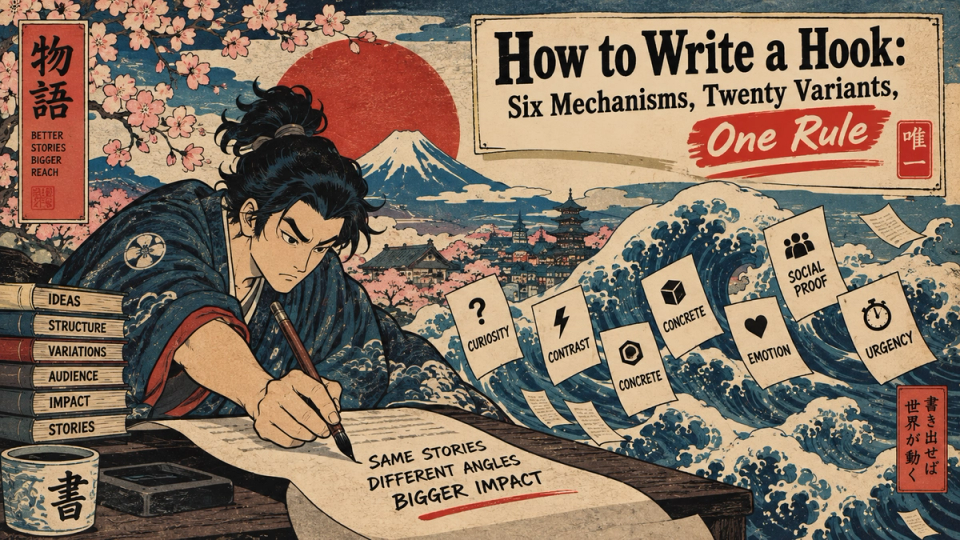
If most of an audience leaves in the first two seconds, no improvement to the rest of the piece can recover them. That makes the opening the sentence that decides the most, which is unpleasant and true, and it is why hooks deserve the same craft attention as an ending.
The reason most hook writing is bad is that people ask for a quality when they want a mechanism. Ask for twenty punchy openings and you get one sentence in twenty costumes. Ask for four openings that contradict a belief, four that name a cost and four that withhold the subject, and you get twelve things that differ in kind.
The six mechanisms
| MECHANISM | WHAT IT DOES | SHAPE |
|---|---|---|
| Contradiction | Creates a gap between what they believe and what you said | "Shortening the clip raised completion by nine points. The edit raised it by one." |
| Cost | Makes the stakes concrete before the subject arrives | "That one setting cost us four days of renders." |
| Specific number | Signals that a real thing was measured | "We ran ninety versions. Twelve shipped." |
| Withheld subject | Opens a narrow curiosity gap | "Nobody warned us about the second one." |
| Admitted failure | Buys credibility, which is a scarce currency in a feed | "We got this wrong for about six months." |
| Mid-action start | Orients by consequence | Opening on the argument itself. |
Two of them can be combined and three cannot. Contradiction plus a number is strong. Withheld subject plus admitted failure is strong. Three mechanisms in one sentence produces a sentence nobody can parse in the second available.
The rule
The hook has to be about the piece. A hook disconnected from what follows works exactly once and then trains the audience that your openings are unreliable, at which point every subsequent piece pays the tax.
This is why hook quality should be measured on the next video. A hook that wins today’s retention curve and loses tomorrow’s first two seconds has cost you money and shown you a graph that says otherwise.
How to generate twenty that differ in kind
- Write the claim first. One sentence, the single true and specific thing the piece proves. If you cannot write it, the hook is not the problem.
- Write what the audience currently believes. One sentence. The gap between these two is the raw material.
- Take each of the six mechanisms in turn and write three or four openings using only that mechanism. Do not mix at this stage.
- Cap the length. Nine words for video, twelve for a headline. The cap does the work that rewriting keeps failing to do.
- Ban the three defaults: the rhetorical question, "in this video", and the word "secret". All three are recognised by audiences as the shape of nothing.
- Read all twenty aloud. The ones that are hard to say are hard to hear, and in a feed the audio arrives before the meaning.
The hook and the scroll stopper are different jobs
The scroll stopper is visual and works before comprehension: contrast, a face at unusual scale, unexpected motion, an incongruous object, large legible text. It buys you the fraction of a second in which the hook can be heard.
A piece can win one and lose the other. If retention shows a cliff at half a second, the visual failed. If it shows a cliff at two to three seconds, the sentence failed. The graph tells you which one to rewrite, and it is worth checking before rewriting either.
Where hooks live outside short-form
- The subject line, which is a hook with no visual support at all and therefore the hardest one.
- The first line of a case study, where the usual failure is opening on the client’s name.
- The cold open of a longer film, which is a hook with a whole scene to do it in.
- The opening sentence of an article, where the same six mechanisms apply and the specific number is the strongest of them.
- The first slide of a pitch, where admitted failure outperforms everything else and almost nobody uses it.
The prompt we use to generate twenty variants by mechanism, and never twenty rewrites of one, in the Prompting Library.
THE HOOK PROMPT →