
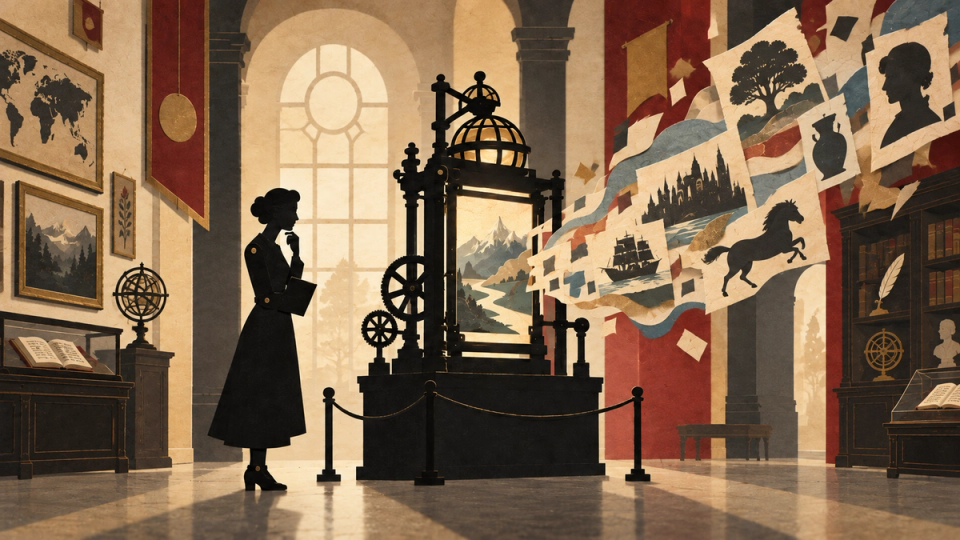
At 1:13 on a Tuesday morning, a designer types “Caravaggio lighting, injured astronaut, supermarket aisle” into Midjourney. Several images arrive. One has the emotional temperature of a perfume advert and gives the astronaut six fingers. Another carries the haunted expression of a regional sales manager opening Excel, yet feels strange enough to keep. Is that art? The comments section has already assembled its tribunal. Online debate fixates on the status of the prompt and skips the part that matters: who made the choices, where the material came from and who accepts responsibility for the result. Generative art belongs inside art history because it makes several old questions impossible to ignore. It also carries an ethical debt that earlier tools never accumulated at this scale.
THE ANXIETY HAS ANCESTORS
Machines have been trespassing in the studio for a long time. Photography unsettled the relationship between craft, reality and reproduction. MoMA describes how nineteenth-century cameras could record the visible world while reinventing it, giving artists new ways to shape time, movement and perspective. The apparatus performed part of the work. Photographic authorship grew around framing, exposure, timing, printing and context. The human hand lost one monopoly and found another job. [MoMA’s account of early photography and film](https://www.moma.org/calendar/galleries/5165) makes that shift plain. Then Marcel Duchamp bought ordinary objects and placed them inside art’s institutional machinery. His readymades treated selection and presentation as creative acts. A snow shovel acquired a title, a gallery and a philosophical headache. [MoMA notes that Duchamp used choice itself as part of creation](https://www.moma.org/collection/works/105050). The current generator combines both provocations. It automates visible craft and gives enormous weight to selection. Picture an unruly relative arriving at the family lunch with five billion pictures and no provenance folder.
THE CATALOGUE DISSOLVED
Think of the model as a museum whose catalogue has been ground into probability. A latent diffusion system learns patterns in a compressed representation of visual data. During generation, it forms an image through repeated denoising, guided by text or other conditions. The original latent diffusion paper describes this architecture through pretrained autoencoders and cross-attention, which connect language to visual synthesis. [The technical paper is available here](https://arxiv.org/abs/2112.10752). The description matters. A prompt activates patterns distributed across learned parameters. Training material still determines the forms the software can recognise, associate and reconstruct. The dissolved catalogue remains present through influence, probability and bias. Human authorship sits around that mechanism. The maker chooses the subject, builds references, tests a model, rejects weak frames, repairs anatomy, changes composition, grades colour and places the final image inside a sequence. Sometimes the entire contribution is one sentence followed by a download. Those two production histories deserve different critical weight. American copyright policy has reached a similar practical boundary. In January 2025, the US Copyright Office concluded that prompts alone generally do not provide enough human control for protection, while creative arrangement or modification may qualify. It also confirmed that using a generator inside a larger human-made work does not disqualify the whole piece. [The Office’s summary sets out that position](https://www.copyright.gov/newsnet/2025/1060.html). Copyright offers a legal test, and aesthetics asks a wider question. Still, the distinction is useful. Typing a request resembles commissioning. Authorship becomes stronger when choices leave visible fingerprints across the finished work.
CHANCE GETS A BADGE
Artists have always worked with accidents. A painter lets solvent run. A director keeps the take where a passing siren changes the scene. Both recognise the surprise’s use without designing it at molecular level. Generation expands that accident into an industrial process. You can ask for a brutalist cathedral made of birthday cake and receive a competent answer during the time it takes to butter toast. The first result may feel miraculous. By image 140, the miracle has acquired a loading bar and a mild HR problem. Selection gives the accident a role in the work. The artist still needs a reason for keeping frame 19 while deleting frame 18. “It looked cool” can be enough for a poster. A serious body of work needs a deeper logic across subject, form and context. Prompt virtuosity also feels fragile. Syntax changes with each interface. Model updates swallow yesterday’s secret incantations. Taste develops through years of looking, making, failing, then noticing why one image stays in the mind. The software produces surprise. The artist decides what deserves to survive.
THE ARCHIVE HAS CREDITORS
The philosophical case cannot stop at intention. Every museum has a loading dock. Large image generators depend on vast collections. LAION-5B, one prominent open research dataset, contains 5.85 billion filtered image-text pairs gathered at web scale. Its size helped researchers study and train multimodal systems, including work related to Stable Diffusion. The dataset paper records the figure and its purpose. Scale changes the moral problem. An illustrator can study a Moebius book, absorb a compositional idea and carry that influence into later drawings. Automated training can process billions of examples under commercial conditions, while the people who produced them may lack consent, payment, credit or a workable route to refusal. Calling both activities “learning” conceals the difference in speed, bargaining power and economic effect. Theft is still too blunt a label for every case. Public-domain archives, licensed libraries, private material and scraped portfolios create separate ethical situations. A model trained on an illustrator’s work with permission occupies a different position from a service that markets imitation of the same living person without agreement. Law will keep drawing borders around these practices. Artists and audiences have to draw cultural ones as well. Legality tells us what a producer may do. Ethics asks what fellow creators should have to endure so somebody else can make a glossy cyberpunk nun before breakfast.
MEANING WITHOUT A GHOST
The machine has no childhood, mortality or private obsession with the colour of a hospital corridor. It does not experience the picture it helps produce. Many people take that absence as a fatal wound. Aesthetic philosophy has spent decades arguing over how much an author’s intention controls meaning. The intentional-fallacy tradition holds that viewers can interpret a work through the object itself, even when the maker’s purpose remains unavailable. Recent experimental research adds a curious wrinkle: participants may classify machine-generated paintings as art while resisting the idea that the system counts as an artist. The Stanford Encyclopedia of Philosophy surveys that finding. That division feels sound. A generated picture can move you because meaning also forms during contact with a viewer. Your memory supplies associations that the software never possessed. Human experience enters at reception, even when the production process contains automation. Emotional effect alone cannot settle authorship. A sunset can make someone cry, yet the atmosphere receives no gallery retrospective. Artistic status and creative responsibility can therefore point to different places. The latter belongs to the person who directed, edited, framed and released the image.
ABUNDANCE IS THE MEDIUM
GenAI alters technique and the conditions under which images compete. When a polished render costs minutes, surface competence loses scarcity. The internet fills with immaculate faces, chrome temples and cinematic fog. Much of it resembles the lobby art of a hotel built inside a graphics card, with a flawless surface that leaves little for memory to catch. Direction gains importance under those conditions. The maker must know which image needs to exist, why it belongs in this form and how it connects to a larger body of thought. Editing becomes a moral and aesthetic act because abundance makes publication cheap. Restraint carries information. The medium therefore includes the rejected material. Two hundred discarded generations sit invisibly behind one chosen frame. Process notes, contact sheets and version history can help an audience judge the human decisions involved. They also expose the difference between considered practice and a lucky spin wearing a black turtleneck.
SIGN THE RECEIPT
My position is simple. Generated work can be art. The label leaves quality and ethical production open to judgement. Oil paint carries the same burden. The artist earns the claim through sustained judgement and responsibility. That duty covers the training archive plus the effect on other creators. It includes honest disclosure when context calls for it. It asks for licensed sources where available, fair credit in collaborative work and enough process to show where the human decisions occurred. Use the generator and interrogate the result. An uncanny mistake may serve the idea. A beautiful frame can still say nothing. Place your name beneath the final image and accept every question attached to it. The receipt gives the viewer enough evidence to decide whether that name belongs there.