
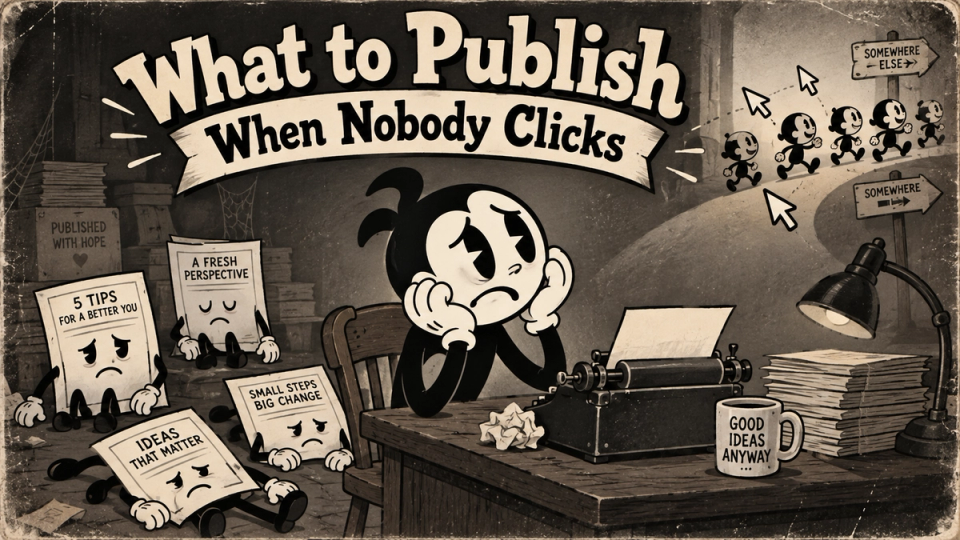
Around two thirds of searches now end without anyone visiting a website. For a content programme built on informational traffic that is not a dip, it is a change in what the programme is for, and pretending otherwise produces a year of writing the same pages while the chart goes down.
What changed
The commodity answer stopped being worth a visit. Anything that could be reduced to a paragraph is now reduced to a paragraph, upstream of your site, composed from several sources including possibly yours. What survives a summary is what cannot be compressed without loss.
That is a narrow, specific category, and most content calendars are pointed somewhere else entirely.
The four page types that still work
| TYPE | EXAMPLE | WHY A SUMMARY CANNOT REPLACE IT |
|---|---|---|
| Original data | Your acceptance rates, your pricing logs, a survey nobody else ran | The number does not exist elsewhere, so quoting it names you. |
| Tools and calculators | A cost worksheet, a decision path, a template | The output depends on the visitor’s input. A summary of a tool is not a tool. |
| A position | An argued opinion with a cost attached | Summaries flatten disagreement. A real position either survives intact or is worth arguing with. |
| Deliberate reference | Definitions, checklists, specifications | Written to be quoted. The mention is the goal. |
What is missing from that table is the general explainer, and its absence is the whole strategic point. "What is generative video" is a page that will never be visited again and should be written anyway, as reference, as an entity anchor, and with no expectation that anyone lands on it.
Metrics that still mean something
- Share of answers: for the twenty questions your buyers ask, how often does an answer engine name you. Checkable by hand in an afternoon, monthly.
- Definitional capture: whether your phrasing of a term is the one being reproduced. This is the cleanest evidence that a glossary is working.
- Query depth of arriving traffic: fewer visitors, further down the funnel, is the expected shape and a good one.
- Branded search volume: the lagging indicator that tells you whether mentions upstream are producing intent downstream.
- Assisted conversions from direct and branded entries, which is where the credit for zero-click work lands.
The uncomfortable trade
Writing to be quoted means answering the question without requiring a visit. You are deliberately choosing mentions over sessions. That is a real cost and worth stating plainly. Pretending there is no tension fools nobody.
The argument for taking the trade is that the alternative is not sessions, it is neither. The answer gets composed regardless; the only decision available is whether it is composed from your page or somebody else’s.
What to do with the freed capacity
A content team that stops producing commodity explainers has recovered a sizeable amount of time. The highest-return uses we have seen:
- Generate one piece of original data per quarter. Your own logs, your own survey, your own test. This is the only durable citation asset there is.
- Build the reference layer properly: definitions on their own pages, linked consistently, dated, with the questions people type as headings.
- Ship a tool. A calculator or a decision path earns links, gets used, and cannot be summarised.
- Say something arguable, in public, with your name on it. Positions get quoted and disagreed with, and both are mentions.
- Put more of the budget into formats that are not text at all, because the substitution pressure there is lower and the same claims travel.
What this looks like when we do it: templates, checklists and calculators published in full, with no email gate in front of any of them.
THE SUPPLY DROP →