This is a working summary written by a production studio and not legal advice. It is also the single biggest cause of a stalled generative project, usually because the two sides are answering different questions.
The copyright position, briefly
The dominant position across major jurisdictions is that copyright requires human authorship. Output generated by a model with minimal human contribution therefore sits somewhere between thin protection and none, with the line drawn differently in different places and still moving.
What tends to attract protection is the human contribution around the generation: the selection, the arrangement, the editing, the compositing, the sequencing, the written elements. A finished film assembled by people from generated components is a different object from a single unedited output, and it is treated as one.
The commercial consequence is that ownership has to be constructed on the page, clause by clause. Nobody gets to assume it.
The four clauses that decide it
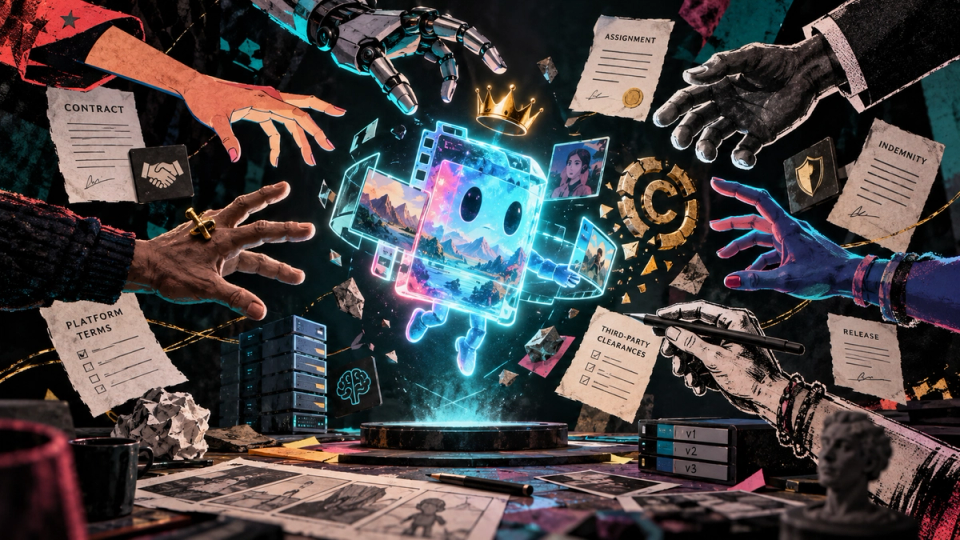
| CLAUSE | THE QUESTION | THE ANSWER YOU WANT |
|---|---|---|
| Platform terms | What does the model provider grant you in the output? | An unambiguous commercial grant, on the plan you are on. Free tiers frequently differ. |
| Assignment | What does the studio assign to the client, and when? | All assignable rights in the deliverables, on payment, including the project files and the lock file. |
| Warranty and indemnity | Who carries the risk if a third party claims the output infringes? | Somebody, explicitly. An agreement silent on this has allocated the risk to whoever gets sued. |
| Third-party material | Are references, likenesses, music or trained identities cleared? | A schedule listing every input and its clearance. That clause saves projects. |
The fourth is the one most often missing and the most likely to matter. Almost every real dispute we have seen in this area concerned an input: a reference image somebody did not have rights to, a likeness without a release, a piece of music cleared for one use and running in another.
What to secure in a deliverable
- The finished assets, in the delivery formats, with no dependency on any account or subscription.
- The project files: edit timelines, composites, layered masters.
- The lock file and the reference set, which is what allows the work to be continued by somebody else.
- The consent files for every real person whose likeness or voice appears, held by the client as well as the studio.
- The input schedule: what went in, where each item came from, and the clearance attached to it.
- The run log, if provenance or substantiation is likely to be questioned later.
A deliverable that requires a specific model, seed or account to still exist is access, and it is worth naming that distinction during the negotiation. Discovering it during a re-version is expensive.
The trained identity case
A trained character or presenter raises its own questions because the artefact is a model. Who holds the weights, who may use them, for what, for how long, and what happens at the end of the term all need stating.
If the training material came from a real person, their release has to grant the derivative-training right explicitly and should specify disposal at the end of term. A release drafted for photography does not cover this, because the concept did not exist when the wording was settled.
A workable position for both sides
The arrangement that has held up in practice: the studio warrants that it holds or has cleared every input, assigns all assignable rights in the deliverables on payment, and hands over the files that make the work continuable. The client accepts that copyright in machine-generated components may be thin and that exclusivity comes from trained assets and contract terms.
That is honest on both sides, and it gives you something to build on. An assignment clause promising what the law currently withholds is a foundation made of paper.
Where rights, clearance and the deliverable specification sit in a brief, before any of this becomes a negotiation.
THE BRIEF TEMPLATE →