
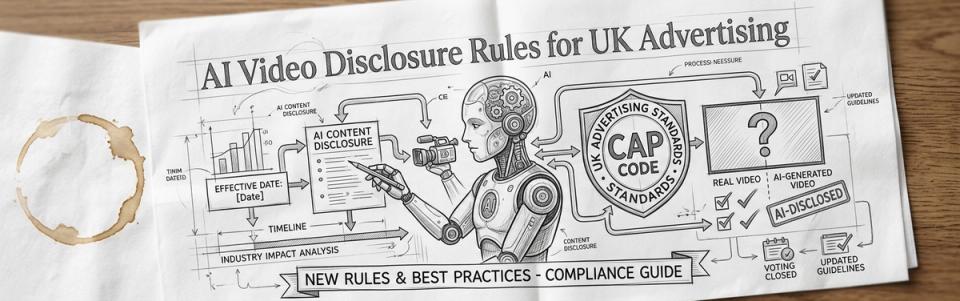
The question we get asked most often, usually two days before a campaign goes live, is whether an AI-produced ad has to say so. The answer is not the one either camp wants. There is no blanket requirement in the UK Advertising Codes to disclose every AI-assisted asset. There is also no safe harbour for staying silent.
What the CAP Code says
The UK Advertising Codes contain no AI-specific rule, and as of late 2026 there is no sign of one coming. The Committee of Advertising Practice has been consistent that the Code is media-neutral and applies regardless of how content was made, which means the operative provision is the general prohibition on misleading by inaccuracy, ambiguity, exaggeration or omission.
CAP frames the practical test as two questions. Would the audience be misled if the use of AI were not disclosed? And, where there is a risk of misleading, would a disclosure clarify the ad or contradict its overall message? That second question is the one people miss. A disclosure that undermines the claim the ad is making is not a fix; it is evidence the claim was the problem.
The ASA set this out again in June 2026, in guidance aimed squarely at deepfakes and automated campaigns. Four points, none of them surprising and all of them worth having in writing: the Code is media-neutral and there is no exception for generated content; deepfakes get no free pass on misleading claims or on endorsements; AI bias is a compliance problem as well as a technical one, because a biased output can carry a harmful stereotype into an advert; and using an automated tool does not move responsibility away from the advertiser.
That last point is the one to take to a platform-buying conversation. An automated campaign that generates its own variants is still your advert, and "the tool made it" has never been a defence.
Where silence stops being defensible
Four categories where an undisclosed generative asset moves from a judgement call to a problem.
- A synthetic person presented as a real customer, user or member of the public. This is the highest-risk category by a distance, because the entire persuasive weight of the format rests on the viewer believing a person exists.
- A product depiction that shows the product doing something it does not do, or wearing a finish it has never had on a shelf. Generative production makes exaggerated depiction trivially easy, which is exactly why it attracts scrutiny.
- Any synthetic endorsement, testimonial or likeness of an identifiable person. Consent is a separate and non-negotiable issue here, before disclosure is even reached.
- Anything in a regulated sector where the underlying claim needs substantiation. Health, finance, supplements, environmental claims. The generative question stacks on top of a substantiation question that already existed.
The platforms run ahead of the regulator
Teams get caught here. The ASA sets a misleadingness standard. The platforms set labelling policies, and those policies are contractual, which means they are enforced by demonetisation and reach suppression, months before any ruling arrives.
Meta and TikTok both operate AI-content labelling regimes with a self-declaration requirement plus automated detection, and both reserve the right to apply a label you did not choose. Getting labelled by the platform after the fact reads as a correction, and it lands once the ad has already been served.
So the operative compliance surface is the stricter of the two, per placement, checked at brief stage.
The EU AI Act now applies to a lot of UK advertisers
Article 50 of the EU AI Act became enforceable on 2 August 2026. It imposes transparency duties on deployers of systems producing deepfakes and synthetic media, requiring disclosure that content has been artificially generated or manipulated, presented clearly and at the point of first interaction.
A UK advertiser is inside this the moment the campaign is served to people in the EU, which for most paid social is the default. There is a narrow carve-out for evidently artistic, creative, satirical or fictional work disclosed appropriately, and one for AI-generated text that has been through human editorial review with a named person holding editorial responsibility. Neither carve-out helps a product ad. Penalties run to fifteen million euro or three per cent of worldwide annual turnover.
Read that alongside the UK position and the practical conclusion is straightforward: for anything running across both markets, the EU standard is the one that determines your process, because it is the specific one.
What we do about it
Our rule predates the regulation and has not needed changing.
- Disclose to the stricter of platform policy and client legal, decided at brief stage and written into the brief, so nobody discovers it at delivery.
- Put the disclosure on the asset itself, as well as in the metadata. A metadata flag protects you with the platform. An on-asset label protects you with the audience, and the audience is the one who can decide you were dishonest.
- Attach provenance metadata as well, because it costs nothing and it is what a platform’s detection reads.
- Never let an invented certification, award, ingredient or percentage survive a gate. This one is not a disclosure question. A frame containing a fabricated claim is killed, and no disclosure rescues it.
- Keep the consent file before rendering, for any likeness of a real person. Signed release in the folder or the render does not start.
A metadata flag protects you with the platform. An on-asset label protects you with the audience. You need both, and only one of them is visible when somebody screenshots the ad.
The disclosure wording itself
Short, plain, and in the same visual field as the claim it qualifies. "AI-generated" or "Created with AI" is sufficient and is what platform policies are written around. Avoid constructions that hedge ("partly enhanced with AI tools") because a hedge invites a reader to work out what was real, which is the conversation you were trying to avoid, now with an audience.
The decision tree above as a one-page checklist covering UK, EU and platform requirements per asset type. Free, no email gate.
DOWNLOAD THE DISCLOSURE CHECKLIST →