
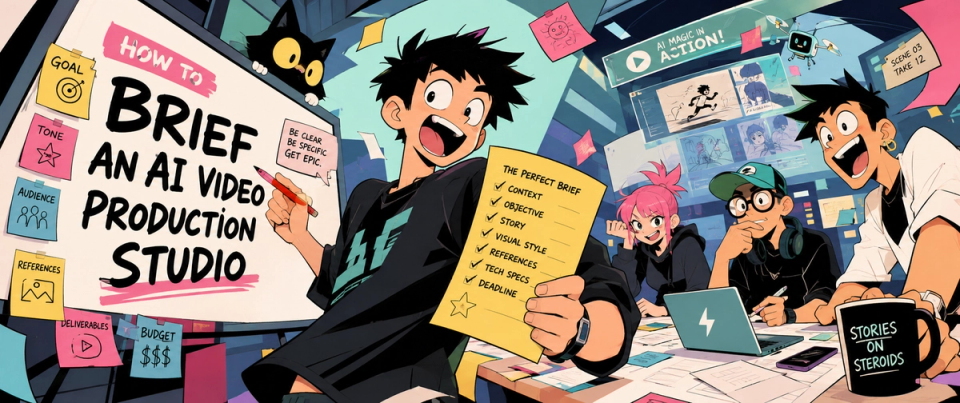
A conventional production brief tells a crew what to shoot. A generative brief has to do something else: it has to tell a studio what must not change. That is a different document, and briefs written from the old template are the most common cause of a generative project going sideways.
The six paragraphs a generative brief needs
1. What must not change
The single most useful paragraph you can write. Name the things that are fixed: the product’s silhouette, the label artwork, the presenter’s face, the brand colour, the exact wording on the pack. Everything named here becomes a lock the studio builds before generating, and a test every frame is measured against.
If nothing is named, the studio has to guess, and it will guess conservatively, which means you pay for headroom the brief never asked for.
2. Where the legible type is
Say explicitly whether any shot requires readable printed text: packaging, labels, signage, screens, certification marks. This is the largest single driver of cost, because type is where acceptance rates collapse. A brief with no readable type in frame is a fundamentally cheaper brief, and a studio that skips this question has not priced the job.
3. Who has to recur
One face appearing in one asset is a render. One face appearing across nine assets is a trained identity, a set of gates and a consent file. State how many assets a given person or product appears in, because the answer changes the shape of the production.
4. What is regulated
Any claim about health, finance, environmental impact, ingredients, performance or comparison brings a substantiation requirement that exists regardless of how the asset was made. Say which claims the asset must carry so the studio can route them through legal before rendering.
5. What disclosure applies
Where is it running, and under whose policy. Platform rules and the EU transparency obligations differ, and the operative standard is the stricter one per placement. Decide it in the brief. Discovering it at delivery means re-exporting every asset, and sometimes re-shooting the composition to make room for a label.
6. Who signs off, and at which points
Name one person, and name the two moments they see the work: the brief, and the final output. A generative pipeline can produce a hundred assets faster than a committee can look at three, and an approval structure designed for one film a quarter will become the bottleneck it was not designed to be.
The rest of the brief, which is normal
- The commercial objective, stated as a number if one exists.
- The audience, in a sentence a stranger could act on.
- Deliverables with aspect ratios and durations per placement.
- The deadline, and whether it is a launch date or a preference.
- Reference material: what you like, and more usefully, what has been rejected before and why.
- Brand assets: artwork at print resolution, fonts, colour values, existing photography.
What a good studio should ask you back
A briefing conversation is diagnostic in both directions. If none of these come up, that is information.
- "Is there readable printed type in any shot?" If they do not ask, they have not priced the hardest part.
- "Should this be generative at all?" A studio that has never talked a client out of a brief is selling capacity.
- "Who owns the plates and trained identities afterwards?" The answer should be you.
- "What is the credit ceiling per asset?" There should be one, and it should halt the run. A logged warning is not a ceiling.
- "What is the expected acceptance rate on the hardest shot?" You want a fraction with two real numbers in it.
- "What happens to a frame that fails review?" Correct answer: back to the source file. Wrong answer: our retoucher fixes it.
What you should get back with the quote
A number on its own is not a proposal. The document should contain a date you can plan around, the named pipeline the work runs through, the control gates and what each one tests, the acceptance-rate assumption per shot type, the credit ceiling, the disclosure position per placement, and a list of what you keep at the end.
That last item is the one worth arguing about. Plates, trained identities and set specifications are the assets with the longest life in the engagement. A studio that retains them is selling you a dependency.
The six paragraphs above as a fillable template, with the questions a studio should ask you printed on the back. Free, no email gate.
DOWNLOAD THE BRIEF TEMPLATE →