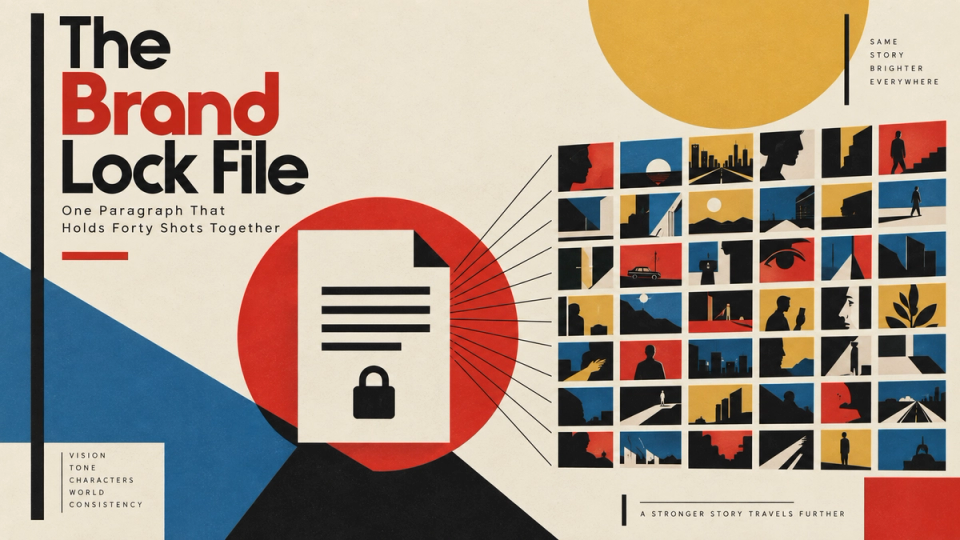
The most common cause of an inconsistent generative campaign is that the person writing shot thirty-one wrote the world description slightly differently from the person who wrote shot four. Nothing dramatic. A colour named differently, a light described from memory, one adjective added. Forty small differences produce a set that nobody can quite defend.
The fix is mechanical and boring, which is why it works.
What goes in it
| LINE | WHAT IT STATES | EXAMPLE |
|---|---|---|
| Palette | Three or four named colours and nothing else | Muted teal, sand, near-black. No other saturated colour. |
| Light | Source, direction, quality and ratio | Hard key from camera left at 45 degrees, no fill, shadow side near black. |
| Time and weather | Fixed, for the whole job | Late afternoon, low western sun, light haze in every exterior. |
| Materials | What surfaces are made of and how they read | Unfinished timber, brushed steel, matte paper. No gloss anywhere. |
| Optics | Focal length family, stop, and character | Anamorphic 40mm look, f/2.8, slight barrel distortion, edge softness. |
| Absence | What must never appear | No lens flare, no volumetric light beams, no text on any surface, no gloss. |
The absence line carries the file, and it is the one most often missing. A model will happily add a lens flare to shot twenty-two because lens flares are common in the material it learned from, and the only defence is having said not to.
What must not go in it
- Anything that varies per shot. Subject, action, camera move, shot size. If it changes, it is not a lock.
- Mood adjectives. "Cinematic", "premium", "energetic" describe nothing a model can hold constant and consume attention at the front of every prompt.
- Brand values. A lock file is a physical specification. Values belong in the brief that produced it.
- Anything you are not certain of. A lock is a commitment; a guess pasted four hundred times is a mistake pasted four hundred times.
How it differs from brand guidelines
Brand guidelines are written for a person who will interpret them. They contain hex values, typography rules, tone-of-voice guidance and photographic direction, and they assume judgement in the reader.
A lock file assumes no judgement. It is written in production language (the words a gaffer, a DP and an art director use), because those are the words a model trained on film responds to. "Warm and human" is guideline language. "Hard key from camera left, no fill, warm key against cool ambient" is lock language, and only the second one produces the same frame twice.
Deriving one from the other is a real piece of work and it is worth doing once per brand and never once per campaign.
Testing a lock file
- Generate six deliberately different subjects using only the lock plus a one-line subject. A wide, a portrait, a product, a hand, an interior, an exterior.
- Put all six side by side. They should look like one world containing six things.
- Anything that differs and should not points at a line that is missing or ambiguous. Add it.
- Repeat once. A lock that survives two rounds of this will survive a campaign.
- Keep the six as the calibration set, because it is also what you will test the next model against.
It is also the handover
A client who owns the lock file owns the ability to have the work continued by somebody else, which is why it should be a deliverable and why some studios quietly do not offer it.
We hand it over, in production language, model-agnostic, with the six calibration frames. It is the difference between delivering assets and delivering a capability, and the second one is a better thing to have sold.
How the lock block sits in front of every shot prompt, in the Prompting Library.
THE SHOT-LIST PROMPT →