
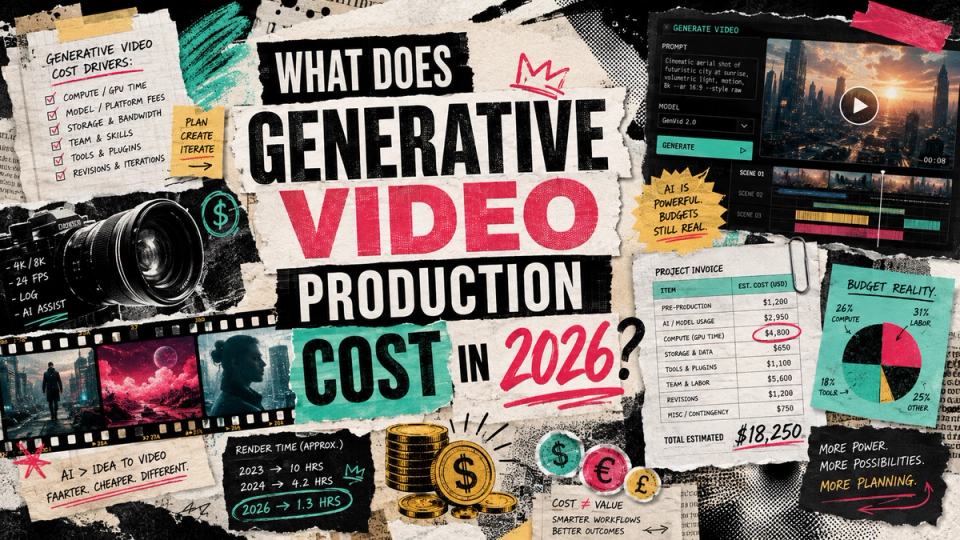
Everybody asking this question has seen two numbers and cannot reconcile them. One is the per-second price on a model provider’s pricing page, which in 2026 runs from roughly five cents to forty cents a second depending on the model and the resolution. The other is a studio quote with a comma in it. The reasonable conclusion is that somebody is lying.
Nobody is. They are prices for different things. One is the cost of a render. The other is the cost of a video you are allowed to publish, that matches the rest of the campaign, that a legal team has seen, and that will still be usable when you need the fortieth variant of it in March. Confusing those two is the single most expensive mistake in this market, and it is usually the buyer who makes it.
The four tiers, and what separates them
There are four realistic ways to get a generative video made in 2026. They are four different products, and a buyer who treats them as a quality ladder ends up paying for the wrong one.
| TIER | TYPICAL COST | WHAT YOU ARE BUYING | WHERE IT BREAKS |
|---|---|---|---|
| Raw model credits | $0.05 to $0.40 per second of output | One clip, from one prompt, with no guarantee about the next one | The second clip does not match the first |
| Subscription tools | $20 to $300 per month | A seat, a credit allowance, templates and an export | Brand control, licensing clarity, anything at campaign scale |
| Freelance generative operator | £400 to £3,000 per project | Somebody who knows the tools driving them for you | No pipeline, so consistency lives in one person’s head |
| Studio engagement | £3,000 to £30,000+ | A locked pipeline, control gates, revisions, licensing, delivery specs | Overkill for a single eight-second clip |
The honest read on that table is that the first two rows are tool costs and the last two are production costs. If your brief is one clip for an internal deck, buy a subscription. If your brief is nine variants that have to feature the same presenter holding the same product with the same label, the first two rows cannot do it at any price, because the thing they are missing is not compute.
Why the per-second price is not the price
An asset is a render that passed a gate. The ratio between renders attempted and assets shipped is the whole economics of this business.
A pipeline that generates sixty frames and ships four has a real unit cost fifteen times its sticker price. Four in sixty is a normal acceptance rate for hard work like packaging with legible type on it. The failure is quoting the sticker price to a client and then discovering the ratio afterwards.
What the studio line item covers
If you have only ever bought the tool, the studio number looks like a markup on compute. Here is where the hours go on a produced piece. Generation is one line out of six.
- Locking the things that must not change. A product becomes a master plate: one clean frame, correct shape, correct label, that every later angle is generated from. A presenter becomes a trained identity built from a sheet of stills, held steady across every later session.
- Writing the set once. One key light direction, one stated colour temperature, one lens language, written down before anything renders, so shot nine and shot one belong to the same world.
- Generation. The cheap part, and a rounding error against the hours either side of it.
- The control gates. Read every printed word at full resolution. Overlay each render on its plate at forty per cent opacity and check the outline has not drifted. Hold one light direction across the whole set. Kill any invented certification, award or ingredient claim.
- The rejected work. The renders that failed a gate and went back to the source file instead of into a retouching pass, because patching produces one shot that passes and a set that still drifts.
- Delivery. Aspect ratios cut as part of the shoot and never cropped afterwards, colour handled once, disclosure applied on the asset as well as in the metadata, and licensing cleared for commercial use before rendering.
What moves the number on a real quote
Five variables account for almost all of the spread between two quotes for what sounds like the same job.
- Legible type in frame. Packaging, labels, signage and anything with a certification mark on it. Type is where generative models fail most reliably and where a wrong render is a legal problem. Budget for a low acceptance rate.
- A human face that has to recur. One face across nine assets is a trained identity and a set of gates. One face in one asset is a render.
- How many worlds. One set with one light direction costs about a quarter of what four locations cost, and the arithmetic holds all the way up.
- Regulated claims. Supplements, finance, health and anything with a substantiation requirement move legal review from a formality to a stage.
- Whether you want the reusable files. Plates, trained identities and set specifications handed over means the next campaign starts from a lock. It costs more once and less every time after.
When generative is not cheaper
Worth saying plainly, because a studio that stays quiet here is selling you something. Generative production costs the same or more when the brief needs a real face, a real place and a real product on the same real day. The arithmetic goes the same way for a client who will only accept a photograph of the thing itself, and for a single hero piece where a small crew and a good DoP would have got there in a day.
Where it is dramatically cheaper is volume, variation and the impossible shoot. Forty product angles. Nine ad variants with one presenter. A restaurant menu that has never been photographed and cannot be photographed in season. A subject that cannot be filmed at all, like a cyberattack on an electricity grid.
How to sanity-check a quote you have been sent
- Ask for the expected acceptance rate on the hardest shot in the brief. A studio that has done this before will give you a fraction. One that has not will say it depends.
- Ask what happens to a frame that fails. "Back to the plate" is the right answer. "Our retoucher fixes it" means the set will drift.
- Ask who owns the plates and trained identities afterwards. If the answer is the studio, your second campaign costs the same as your first.
- Ask for the credit ceiling per asset and what happens when a batch reaches it. It should halt and ask you first.
- Ask for a date. A studio with a pipeline can give you one.
We publish the arithmetic we use to quote, including the acceptance-rate assumptions per shot type. Free, no email gate.
OPEN THE COST CALCULATOR →The short version: a price per second prices compute. A price per accepted asset prices the production. Put the second one in your plan and the first one in your notes.