
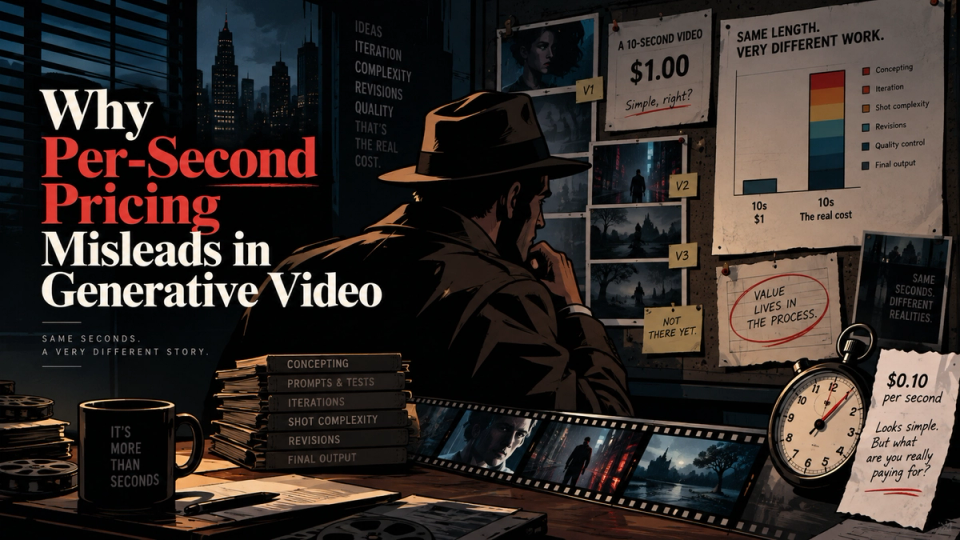
Somebody sends a link to a model’s pricing page and asks why the quote comes to more than that number times the runtime. It is a fair question, and the answer is that the pricing page prices a generation, while a film is made of decisions.
The four multipliers
| MULTIPLIER | TYPICAL RANGE | WHAT IT IS |
|---|---|---|
| Attempts per usable shot | 3× to 15× | The inverse of your acceptance rate. Lower for environment plates, brutal for legible packaging type. |
| Overgeneration for length | 2× to 3× | You generate eight seconds to use three, because the stable window is at the front of the clip. |
| Coverage | 1.3× to 2× | Alternative takes and sizes, generated because an editor needs choice and re-running later costs more. |
| Edit attrition | 1.2× to 1.6× | Shots that were fine and got cut. This happens in every production ever made and is not a generative problem. |
Multiply the ranges out and the published rate is somewhere between eight and roughly a hundred and thirty times short of the production cost, with most real jobs landing in the eight-to-twenty band. That is why the honest unit is cost per accepted asset.
Why acceptance rate dominates everything
The first multiplier dwarfs the other three and swings hardest, which makes it the one worth attacking. Halving your attempts per usable shot halves the production cost of the whole job; shaving the overgeneration ratio saves you a few per cent.
And acceptance rate is a function of decisions made before any generation happens. What is locked. Whether legible type is in frame. Whether the shot needs a hand. Whether a face has to be the same face as the last shot. A brief that resolves those before the first render costs a fraction of one that resolves them by regenerating.
The credits problem
Most platforms price in credits and never in currency, and credits are deliberately not comparable across platforms. Different resolutions, different durations, different features consuming different amounts. Converting to a common unit is a spreadsheet exercise everybody skips.
The unit to convert to is currency per accepted second of finished footage, counting only the seconds that made it into the cut. Once every platform is expressed in that unit, the comparisons stop being marketing and start being procurement.
What a defensible quote looks like
- A shot count. Runtime is an output; shots are what you buy.
- A shot-type breakdown, because acceptance rates differ by a factor of three or four between categories.
- An attempts assumption stated openly, drawn from the studio’s own logs on comparable work.
- A ceiling per shot, with a stated rule for what happens when it is reached.
- A separate exploration line, capped, so discovery does not eat the production budget.
- What is excluded: licensing, disclosure review, consent files, market variants.
A quote with those six things can be wrong, and if it is, you will be able to see where. A quote that is a runtime times a rate cannot be wrong in any way you can inspect, which is a different and worse property.
The case for per-second pricing anyway
None of this makes per-second rates useless. They are the right unit for comparing raw compute cost between models and for sizing an exploration budget.
For a client quote, a campaign budget, or any sentence containing the words "AI video costs", the accepted-asset number is the one you need, and the only place it comes from is somebody’s logs.
The arithmetic above as a worksheet, with our starting acceptance rates per shot type to budget against until you have your own.
THE COST CALCULATOR →