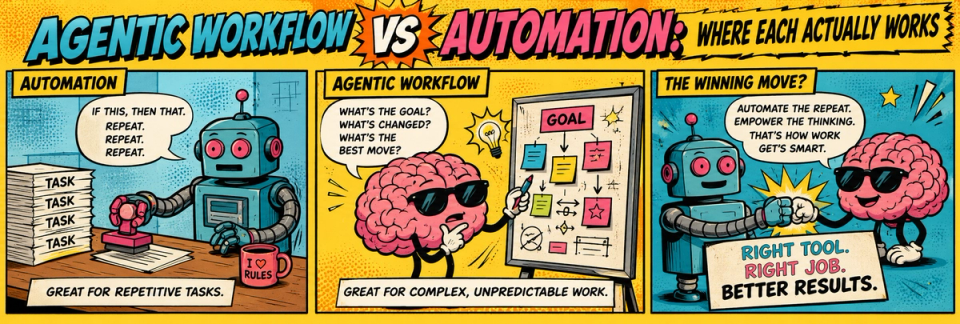
The category has been sold as a progression: automation was the old thing, agents are the new thing, and any process still running on a rules engine is technical debt. That framing has cost a lot of teams a lot of money, because it is wrong in the specific way that matters.
They are not versions of each other. They are answers to different questions.
The actual difference
| CLASSIC AUTOMATION | AGENTIC WORKFLOW | |
|---|---|---|
| Path | Fixed, drawn in advance | Chosen at runtime within boundaries |
| Failure mode | Breaks visibly when input shape changes | Proceeds confidently down a wrong path |
| Cost profile | Flat and predictable | Variable, needs a ceiling |
| Debuggable by | Reading the diagram | Reading the run log |
| Right for | Work that must never vary | Work that always varies |
| Wrong for | Briefs, research, drafting, triage | Billing, payroll, permissions, compliance filings |
The row worth sitting with is the failure mode. A broken automation stops and shouts. A confused agent keeps going and produces something plausible. Plausible-and-wrong is the expensive category, and it is the one teams are least prepared for because their monitoring was built for the other kind.
The decision rule
One question, asked about the process and never about the technology: how many distinct shapes does the input arrive in?
- One shape, always. Automate it with a script. An agent here is a more expensive, less reliable script that occasionally invents a step.
- A handful of shapes you can enumerate. Automate it with branches. Still not an agent; you already know the paths, so encode them.
- Too many shapes to enumerate, and new ones keep appearing. This is where an agentic workflow earns its cost, because the alternative is a person doing it or a rules engine that is permanently three cases behind.
- Unbounded shapes and an expensive failure. A person, with a model assisting. Not a workflow.
Where agents earn their keep in creative work
In content operations the variance is real, which is why this is one of the honest use cases.
- Repurposing. One article into a cutdown, a carousel, three infographic frames and a podcast read. The source varies structurally every time, so a template breaks and an agent adapts.
- Research and qualification. Go and find the thing, check it against criteria, present it in a format a person can act on. The web does not arrive in a fixed shape.
- Draft generation against a brief. Not final copy. Drafts, which a person then edits, which is four hours off the week.
- Format matrices. Nine placements, four aspect ratios, three lengths, and the rules for what survives a crop differ per asset.
- Triage. Reading an inbound brief and routing it, with the interesting ones flagged for a human and none of them answered.
Where agents should not go
Four categories, and the reasoning is the same each time: the cost of a plausible wrong answer exceeds the cost of the work.
- Anything that moves money. Billing, refunds, budget allocation, bid adjustment above a threshold.
- Anything that grants access. Permissions, credentials, sharing, publication rights.
- Anything with a regulatory filing at the end of it.
- Final approval on anything that will be seen by the public. A person signs off the brief and the final output at any volume. We have never found an exception worth the risk.
What makes an agentic workflow survive contact with a real team
The intelligence is not the hard part in 2026. The unglamorous scaffolding is, and it is what separates a system still running in month six from a demo that worked once in front of an audience.
- A directory of skills the model loads on demand, in place of one enormous instruction nobody can edit safely.
- Connectors into the software the team already runs. A workflow that requires a new tool requires a change-management project.
- A naming convention, so the output of a run in August is findable in November.
- A run log with cost attached, which is what turns "it saves time" into a number a finance team can audit.
- A stated stopping condition and a credit ceiling, so a confused agent halts before it spends.
- A named human gate at the points where a wrong decision is expensive.
A prompt gets you one answer. An agentic workflow gets you a job that runs. The difference that matters commercially is not intelligence, it is scope.
The honest hybrid
Almost every system we have built is both. The agentic part reads the brief, chooses the approach and drafts. The deterministic part renames the files, files them in the right place, queues the render, applies the naming convention and writes the ledger.
That split is the design. Put the judgement where judgement is needed and the determinism everywhere else, and you get a system that is both adaptable and auditable, which is the only combination that survives an operations review.
A one-page canvas for mapping a creative process step by step, marking what a person decides, what a model drafts and what a script handles alone. Free, no email gate.
DOWNLOAD THE WORKFLOW CANVAS →