
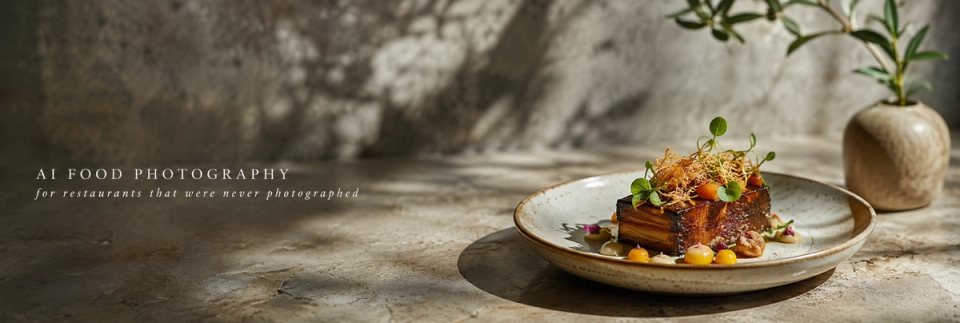
A restaurant on Rhodes came to us with a menu that had never been photographed. Not badly photographed. Not photographed. The season made a shoot impractical, the budget made a food stylist impossible, and the website had been running on stock images of food nobody there had ever cooked.
This is the normal situation for independent hospitality across Greece, Spain, Italy and most of the UK outside the groups. And it is the brief where generative production stops being an interesting option and becomes the only one.
What the honest comparison is
The argument against synthetic food imagery is usually made against a photograph. That is the wrong comparison for this segment, because the photograph does not exist and was never going to.
| OPTION | REALISTIC COST | WHAT YOU GET | WHY IT USUALLY DOES NOT HAPPEN |
|---|---|---|---|
| Professional food shoot | £1,200 to £4,000 per day | The real dishes, correctly | Kitchen closure, stylist, season, budget |
| Phone photography by staff | Free | Inconsistent light, no set, unusable at size | It is what most sites already run on |
| Stock imagery | £20 to £200 | Food from a different restaurant | Dishonest, and customers notice |
| Generative, plate-locked | £400 to £2,500 per menu | Your dishes, one light, one world | Requires the dishes to be documented first |
Row four is only honest if row four is built from your food. Which brings us to the part that matters.
The rule: it has to be your dish
Generating a beautiful generic moussaka and putting it on a menu is stock imagery with extra steps, and it carries the same problem: a customer orders the picture and receives something else.
So the method starts with documentation. Someone in the kitchen photographs each dish on a phone, plated as it leaves the pass, in daylight, from three angles. Badly is fine. What matters is that it is accurate: the real plate, the real portion, the real garnish, the real colour of the sauce.
Those phone frames become the plate lock. Every finished image is generated from them and tested against them, exactly the way a product shot is tested against a master plate. The generative work is doing the lighting, the surface, the depth and the consistency. It is not inventing the food.
Building the set specification
A menu is a set. Thirty dishes shot in thirty different lighting worlds looks like thirty stock images, which is the failure this whole method exists to avoid.
- One light direction, taken from the restaurant’s actual room. If the terrace faces west, the light comes from the west, at the hour people eat there.
- One surface, matching the real tables. A Greek taverna does not photograph well on slate.
- One depth-of-field language. Pick shallow or deep and hold it across the menu.
- A prop rule. Cutlery, napkin, glass, and nothing else. Props are where a set drifts fastest.
- A crop rule per placement. Menus, delivery platforms and Instagram want different shapes, and cropping after the fact loses the dish.
What this cannot do
Worth saying plainly, because a studio that will not is selling you something.
- Interiors with real people in them. Staff and guests are a shoot, and a synthetic diner in a real restaurant is a disclosure problem you do not want on a menu.
- A dish that has not been documented. No kitchen reference, no plate lock, no honest output.
- Anything where the customer expectation is the photograph itself, such as a Michelin-level tasting menu where the plating is the product.
- Legible printed text in frame. A wine label, a menu card, a certification. Same acceptance-rate problem as any other production, and it is the one thing to keep out of the composition.
Where the Greek market sits specifically
Seasonality is the structural problem. A taverna that trades hard from May to October has no window in which a shoot is both affordable and possible: in season the kitchen cannot stop, and out of season the produce, the light and half the menu are gone.
Documentation, though, is free and can happen during service. A chef photographing plates as they leave the pass in August produces the reference set for work that gets made in November and published in March. That sequencing is what makes the arithmetic work, and it costs nothing but a decision made in August.
We work in English and contract from the UK, which for a VAT-registered business in Greece is an unremarkable reverse-charge invoice. Nothing about this requires anybody to fly anywhere, which is why the Rhodes work happened at all.
The full engagement: the problem, what we made, the result and the artefacts, including the film and the website.
READ THE MARIPOSA CASE STUDY →