
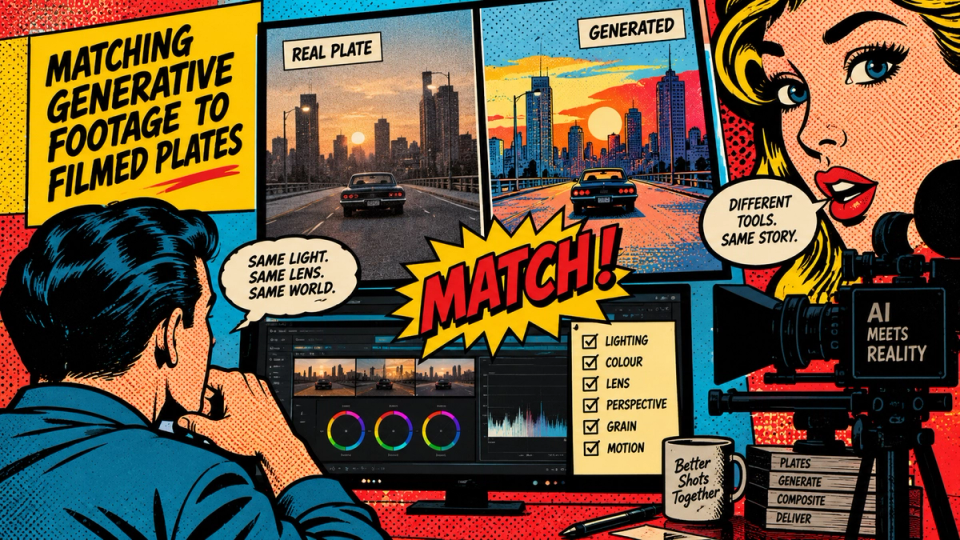
Almost every serious generative job is now a hybrid. Something real gets filmed (a product, a face, a hand, a location), and the rest is generated around it. The join is where the work is, and the join fails for a small number of reasons that are entirely predictable.
The eight properties, and where each is solved
| PROPERTY | FIX IT | WHAT GOES WRONG |
|---|---|---|
| Light direction | On set and in the lock file | The single unfixable mismatch. No grade moves a key light. |
| Camera height and lens angle | On set | A shot from chest height cannot be matched by one from eye height. |
| Depth of field | On set and in the render | Different focus falloff reads instantly as two cameras. |
| Lens character | In the render | Distortion, vignette and edge softness. Nameable in a prompt. |
| Motion blur | In the render | Shutter behaviour has to match or the movement feels different. |
| Colour temperature | In the grade | A grade problem, and the easiest of the eight. |
| Black level and contrast | In the grade | Generated blacks are frequently lifted. Match the toe of the curve. |
| Grain | In the grade | One grain layer over everything at the end. |
The top two rows are the ones that decide whether a hybrid shoot is possible at all, and both have to be settled before anybody films anything. That is an unusual demand on a schedule and it is not negotiable.
What to capture on set for the generative half
Twenty minutes of reference capture saves a week of matching. The list is short and almost never done:
- A grey ball and a chrome ball in the key light, at the subject’s position. This is the light direction and quality, recorded.
- A colour chart in the same light, shot on the same camera at the same settings.
- A clean plate of the background with nothing in it.
- A lens grid, or failing that, a straight-edged object at the frame edge, so distortion is measurable.
- The camera height, the focal length and the stop, written down. Not remembered.
- A short clip of the empty set with the camera doing the intended move, which gives you the motion character to match.
Prompting to match filmed material
The lock block for a hybrid job runs longer, and it is written from the on-set notes.
Every shot: 35mm equivalent, f/2.8, camera at chest height. Hard key from camera left at roughly 45 degrees, no fill, shadow side near black. Late afternoon, warm key against cool ambient. Slight barrel distortion and edge softness. Shallow depth of field, background falls off within two metres. Fine grain throughout.
Every clause in that block corresponds to something measured on set. That is the difference between a lock file that produces matched material and one that produces material that looks nice separately.
The grade approach
Grade everything to a single reference. Pick one filmed frame as the target and pull every generated clip to it. Matching clip two to clip one and clip three to clip two accumulates error, and by clip nine the sequence has drifted somewhere nobody chose.
Then put one grain layer, one halation and one very slight lens artefact over the entire finished piece. A shared surface is where perceived coherence comes from, and per-clip work will never reach it, because the surface gives the audience a single physical explanation for everything they are looking at.
What to put in front of a lens
- The product, if its appearance is the claim. Always.
- Hands doing something specific, which is two hours and a phone camera against a neutral background.
- Anything with legible type on it.
- A long unbroken take, where the value of the shot is that it did not cut.
- A face that has to carry a performance and not merely a look.
And what to generate: environments, weather, scale, crowds at distance, anything unbuildable, and everything that would have been a location scout, a travel day and a permit.
Why generated and filmed material drift apart in the grade, and the reference-frame discipline that stops it.
COLOUR MANAGEMENT, DEFINED →