
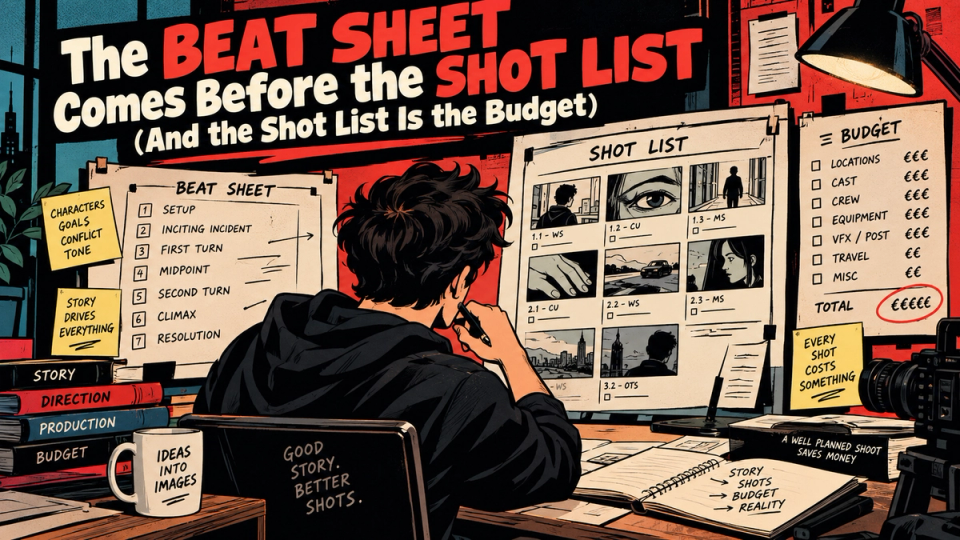
In conventional production the schedule is the budget, counted in crew days. In generative production the shot list is the budget, because each distinct shot is a set of attempts and the attempts are the cost. That makes the document upstream of the shot list (the beat sheet) the most financially consequential page in the project, and it is usually the one nobody writes.
What a beat sheet is
One line per beat, and each line states the turn. What the character wants going in, what stops them, how it ends, and what is different coming out. A list of events that does not name what changed is a running order, and a running order cannot be wrong, which means it cannot be improved.
A ninety-second piece usually supports six to nine real beats. More than that and the beats are events, which is what makes a short film feel busy and empty simultaneously.
The line that makes it useful
Write each beat in this shape and the diagnosis comes free:
She wants him to admit he read the email. He deflects by changing the subject twice. She stops asking, and now he knows she has stopped asking. Trust: negative to worse.
Four elements: an objective, an obstacle, an outcome and a value shift. If any of the four cannot be filled in, that beat is the one to fix, and fixing it costs a sentence.
Deriving the shot list, and where the money appears
Once the beats are settled, each becomes a small number of shots. This is the step where a structural decision becomes a number, and it is worth doing explicitly. Instinct prices it wrong.
| IF THE BEAT NEEDS… | SHOTS | ATTEMPTS MULTIPLIER | WHY |
|---|---|---|---|
| A wide with no people | 1 | Low | Environment plates have the highest acceptance rate of anything. |
| A recurring face | 2-3 | Medium | Identity has to be conditioned and checked against the reference. |
| Legible product type | 1-2 | High | Type is the least reliably reconstructed thing there is, with no partial credit. |
| Hands doing something | 2 | High | The failure everybody sees, and the first one an untrained viewer catches. |
| Two people interacting | 3-4 | High | Geometry, facing and identity all have to hold at once. |
| A dialogue exchange | 4-6 | Medium | Coverage, and lip-sync adds a separate failure mode. |
Run that table over a beat sheet and the expensive beats identify themselves before anybody has generated anything. One beat frequently accounts for a third of the projected cost, and it is rarely the beat anyone would have guessed.
Testing the sheet before deriving anything
- Replace every "because of that" with "and then". If nothing is lost, you have a chronology.
- Check every beat has a value marked at both ends. Identical marks mean the beat is delivering information.
- Find the reversal. If nothing inverts anywhere, the middle will drag regardless of the shot count.
- Read the first beat and the last beat only. They should describe a change. If they describe the same state, the piece does not arrive anywhere.
- Count the beats. Above nine on a short, start merging.
Why this discipline slipped
Because generation is available before writing is finished, and it is more fun. The historical constraint that forced a script to exist first was cost, and cost has moved to a different part of the process without moving the requirement.
The consequence is a specific and now common failure: a project with forty beautiful shots and no budget left to give them a spine. Every one of those we have been asked to rescue would have cost a fraction of the rescue fee to prevent with an afternoon and a page.
Where the beats, the locks and the shot list sit in a brief somebody can quote from.
THE BRIEF TEMPLATE →