
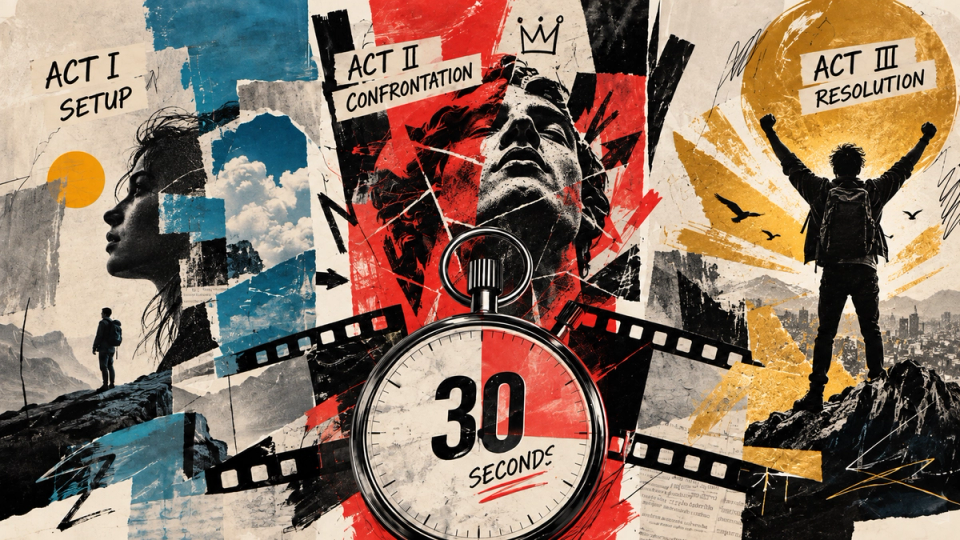
People assume short lengths need a different structure. They mostly do not. What changes is the tolerance: at ninety minutes you can spend four scenes establishing a want, and at thirty seconds you get one shot. The shape survives; the margin for anything that is not doing work disappears entirely.
The allocation
| ACT | 30 SECONDS | 90 SECONDS | WHAT IT MUST CONTAIN |
|---|---|---|---|
| One: situation | 5-8 seconds | 15-25 seconds | Someone, wanting something, in a world with a rule in it |
| Two: complication | 12-18 seconds | 40-55 seconds | The want obstructed, and one attempt that fails |
| Three: resolution | 5-10 seconds | 15-25 seconds | The answer, and the changed state |
The failed attempt in act two is the piece most often missing. Without it there is no complication, only a delay, and an audience reads a delay as padding, however well shot it is.
The beat that always gets cut
In a commercial edit, the first thing to go when the piece runs long is the failure. It feels expendable because it is the part where the product does not work yet, and because somebody in the approval chain is uncomfortable with a shot in which things are going badly.
Cutting it is what produces the advert where a person has a mild inconvenience and then does not have it. That is a description of a purchase, and it converts accordingly.
Compression techniques that work
- Start after the setup. Open on the situation already in progress and let the audience infer the ordinary world from what is being disrupted.
- Let one object carry act one. A specific prop can establish a person, a job and a stake in two seconds where dialogue needs eight.
- Overlap acts. The complication can begin in the same shot the situation ends, which buys two or three seconds and reads as pace.
- Cut the establishing shot. It is almost always the least informative six seconds in the piece.
- Give the resolution one image and no explanation. The changed state, shown once, beats any line stating it.
When three acts will not fit
At six or ten seconds it will not, and forcing it produces a piece that gestures at three things and lands none. Four alternatives, each of which is a complete shape.
Kishōtenketsu. Four parts with a turn instead of a conflict: setup, development, an unexpected juxtaposition, and the beat where it lands. It is the native structure of the four-panel comic and of a large share of what performs in short-form video, and it works where no antagonist is available, which is most brand contexts.
Setup and payoff, alone. Two beats. Plant something in the first half and return to it in the second with a changed meaning. This is a complete structure in its own right.
The single reversal. One state, inverted once. Nothing else. Its whole strength is that the audience has time to register both states.
The list with a break. Three parallel things and a fourth that breaks the pattern. Structurally a joke, and it works for the same reason jokes do.
Testing a short before it is made
- Write it as a question beginning with "will". If you cannot, you have a description.
- Write the three beats with seconds against each. If they total more than the runtime, you have found the problem before it cost anything.
- Point at the failure. If there is no shot in which the want is obstructed and an attempt does not work, add one or accept that this is a demonstration film.
- Check the resolution is shown. A stated one is not earned. A line that announces the outcome is a beat that was not earned.
- Read the whole thing aloud with a timer. Almost every draft is fifteen per cent longer than its slot and the fifteen per cent is always in act one.
The four-part structure that turns on juxtaposition, with no conflict in it, and why it suits brand work with no available antagonist.
KISHŌTENKETSU, DEFINED →