
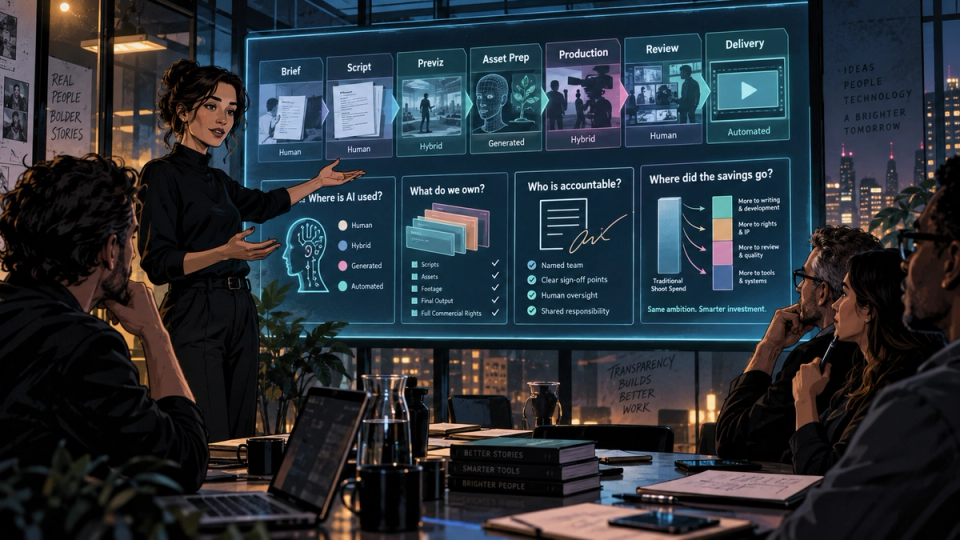
A few years ago the awkward question was whether you used generative tools at all. It stopped being awkward because almost everybody does, somewhere. Previsualisation, versioning, asset preparation, clean-up, localisation. The question that replaced it is sharper and better: who is capturing the efficiency, and what am I buying.
The four questions procurement asks now
| THE QUESTION | WHAT IT MEANS | A GOOD ANSWER |
|---|---|---|
| "Where in this process is AI used?" | Am I paying craft rates for automated steps? | A stage-by-stage list. Not a policy statement. A list. |
| "What do we own at the end?" | Can we continue this without you? | Assets, project files, lock file, consent files, input schedule. |
| "Who is accountable if it is wrong?" | Is there a human signature on this? | A named person, at named checkpoints, at any volume. |
| "Are we getting the saving?" | Has the price moved with the cost? | An honest account of where the cost went, because it moved. |
The fourth is the one studios fear and the one worth meeting head-on, because the true answer holds a room. The cost did not disappear; it moved from shooting to writing, rights, review and systems. A client who understands that is buying the right thing. A client who is told nothing assumes the saving was pocketed, and they are sometimes correct.
What to put in the pitch, unprompted
- A stage map with the method against each stage: filmed, generated, hybrid, automated, or human-only. One page.
- What is human at every volume: the brief, the structure, the creative decisions, the final sign-off.
- The deliverable specification, including what makes the work continuable without you.
- The disclosure position for the finished work, decided now, at brief stage, to the strictest of platform policy, advertising code and applicable law.
- The consent position for anybody appearing in it.
- Where the budget goes, as a proportion. This single slide is what turns the room. The showreel gets nodded at.
What not to do
- Do not present a generated frame as filmed. It will be found out, and the cost is the relationship.
- Do not board at a fidelity you cannot deliver. A photoreal board for an uncertain shot is a promise somebody will hold you to.
- Do not quote a traditional rate for an automated stage and hope nobody asks. They now ask.
- Do not treat disclosure as the client’s problem. Legal responsibility usually sits with the advertiser, and a studio that will not advise on it has not read the rules.
- Never claim the work is entirely human. It ends relationships, and it is entirely avoidable.
When the client does not want AI used
Some do not, for reasons ranging from brand positioning to talent agreements to their own client’s policy. That is a legitimate constraint and it should be taken at face value and never argued with.
What it needs is precision, because "no AI" means different things to different people. Does it exclude generative imagery in the final asset? Generative previz that nobody sees? Automated versioning? Machine transcription? Upscaling? Most people mean the first and are surprised to learn how much of the last four is already standard in every post house they have ever used.
Write the boundary down, in the brief, in specific terms, and price against it. A constraint that everybody understands is workable. A constraint nobody defined is a dispute waiting for a delivery date.
Where the method, the locks, the disclosure position and the deliverable specification sit, before any of this becomes a conversation about trust.
THE BRIEF TEMPLATE →