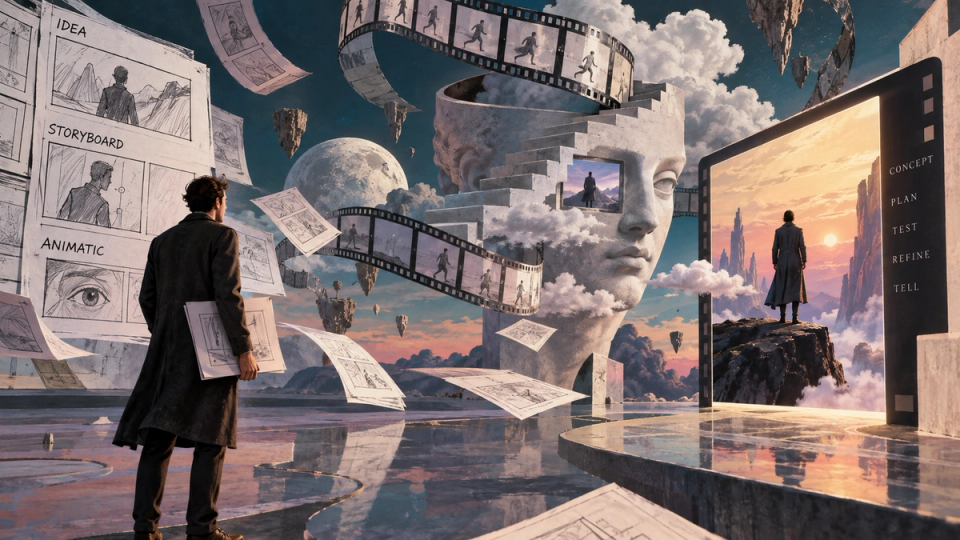
A storyboard has always been a communication device with a deliberate amount of abstraction in it. The abstraction was the point: everyone looking at a sketch understood they were agreeing to a composition. Generated boards removed the abstraction without removing the uncertainty, and that combination is where the trouble is.
What they are good at
- Blocking. Where people stand and who faces where, resolved in minutes, where it used to take a day of sketching.
- Coverage decisions. Generating the same beat as a wide, a medium and a close and looking at all three before committing.
- Pacing. Assembling boards into an animatic with the real intended durations exposes a slow middle on the first pass, while a read-through leaves it buried.
- Alternatives. Six versions of a difficult beat is now an affordable question.
- Internal alignment. A director and a producer arguing about a shot can now argue about an image instead of about a description, which shortens it considerably.
What connects all five is that they are decisions about structure and geometry, where being roughly right quickly beats being exactly right slowly.
The four ways they mislead
| THE BOARD SHOWS | WHAT IT IMPLIES | THE REALITY |
|---|---|---|
| A perfect face | That face, in that light, in the film | It is a different person in every frame unless identity is conditioned. |
| Legible packaging | The type will read | Type is the least reliable thing to reconstruct, and the board did not have to hold it for 96 frames. |
| A complex camera move | The move is available | A still cannot fail at motion. The shot can. |
| A crowd | That density is deliverable | Every background figure is a chance to see a wrong hand. |
All four are the same underlying error: a still image does not have to survive time, and everything expensive about generative video is a function of time.
The animatic is the artefact that earns its keep
A board is a set of compositions. An animatic is a structure with durations, and durations are where films fail. Cutting boards to the intended timings, with scratch voice and temp music, tells you within one viewing whether the piece has a slow middle and whether the ending lands.
It is also the cheapest possible place to discover that a beat does not work. A dead beat costs a still to fix at this stage; the same discovery after rendering costs the shots.
A workable process
- Beats first, in text. Boards generated from an untested structure are expensive-looking versions of the same problem.
- Generate boards deliberately rough for anything you are not certain of. Fidelity is a claim.
- Cut the animatic to real durations immediately, before refining any frame. The timing question is the one that matters.
- Fix structure at animatic stage. This is the whole point of the exercise and the step most often skipped in the excitement.
- Only then raise fidelity, and only on the frames a client needs to approve.
- Carry the approved boards forward as reference frames into production, so the board and the shot share conditioning and hold the same geometry.
The thing boards cannot previsualise
Performance. A still can show a pose and cannot show a delivery, and the difference between a shot that works and one that does not is very often two seconds of a face doing something small before a line.
This is why an animatic with scratch voice outperforms a beautiful board set by a distance. The voice supplies the thing the pictures cannot, and half the notes on a first animatic turn out to be about timing that only exists once somebody is speaking.
What previz is for, what it is not, and where the generative version changes the economics.
PREVISUALISATION, DEFINED →